Final Fantasy X is a turn-based JRPG and uses the conditional turn based system to determine the order in which combatants go. It is conditional in the sense that the action a character is using determines the placement in the turn order for subsequent turns. Using Action A may place you earlier or later in the turn order than Action B. The goal of this post is to look at whether these turn order changes should be looked at more carefully than faster == better, i.e. whether specific configurations of turn orders, such as Character A following Character B, matter, and if so, how, and if not, how they can be made to matter. After all, the information is there - it can be reasoned about. Turn order changes in Final Fantasy X, yes, so what?
Quick Basics and Visualization
In Final Fantasy X, characters take turns based on individual countdowns that we fast-forward through until a character is ready. For us, it is enough to know that these countdowns are affected by 2 things: The character’s Agility stat as well as a speed property that comes with every action. More detailed information can be found in this GameFAQs guide by SinirothX.
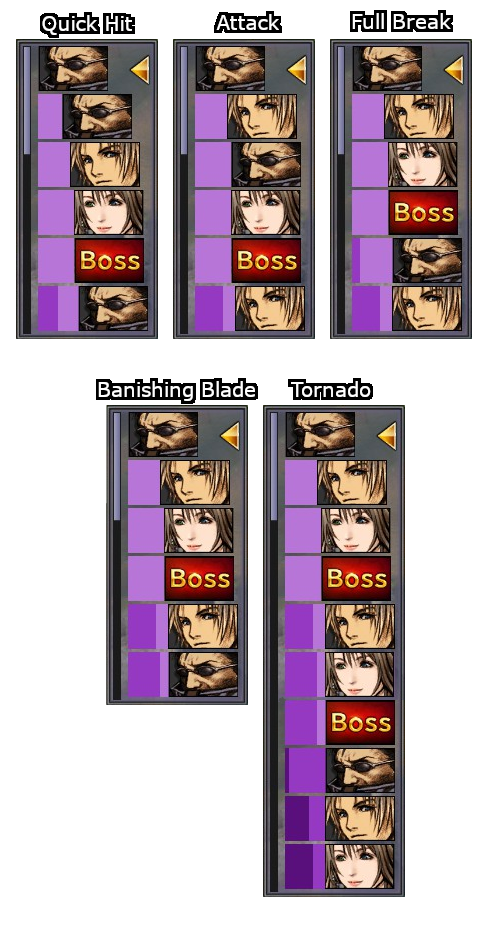
Choosing quicker actions for a character will have their next turn come around faster, and vice versa for slower actions. The game visualizes this as a turn order, using purple bars next to the character icons to communicate how soon they happen and how close the characters’ turns are relative to each other. The character currently taking their turn has no bar and is located at the top.
The important bit here is that we get to see how an action affects the turn order before we commit to it. This means that we can think about turn placement in addition to the effect of the action itself and any resource costs that may be tied to that action, rather than having to guess the outcome as far as the turn order is concerned.
To what extent do I care about speed?
At a glance, I think the effects of actions are easier to reason about in this game: Weaknesses, immunities or the general condition of my characters are knowledge or feedback that I can make use of pretty directly and don’t require much or any interpretation. Similarly, taking more turns before the enemy takes theirs is generally a net positive, so if there’s no other factors that are pushing us away (e.g. MP cost), spamming Quick Hit for its speed (visualized above) makes sense. Beyond that, though, things get a little tricky.
All of these actions change the turn order in a different way, and some seem more immediately impactful than others. Tornado, for example, results in Auron losing out on the ability to react to a boss turn. As for the others: Do we care about the specific position the character is going to be in the turn order, like in the example of Quick Hit vs. Attack? Do we care about which characters are adjacent to Auron?
Abilities that may benefit from sequence
Before I get into the weeds, I want to mention a few things. Where I would start looking here first is (de-)buffs. A lot of the time, anything temporary that characters may benefit from can be made use of pretty effectively if you focus on applying it quickly and keeping it active, while not wasting resources on reapplying it too early, resulting in a bit of a rhythm where sequence can matter periodically. This is especially true in situations where you may have to adjust your actions so that these buffs can be used in the first place, resulting in a bit of a “I need a setup for the setup”-puzzle situation, which can be fun.
What I figured out in this process, however, is that buffs in particular, such as Cheer (Strength and Defense buff in one, stacks multiple times) or Haste (speed increase) last indefinitely and are retained through character switching, meaning there is no setup and payoff rhythm to be found here, as far as buffs are concerned. Nevertheless, I will mention them for completeness’ sake, and because it’s interesting that they last forever.
Moving on to abilities that do benefit: Copycat. Copycat copies the previous (friendly) unit’s action, skipping units whose actions were things like switching armor/weapon or overdrives and summons. This is specifically built on sequence, but acquired late in the game. Additionally, we can see that considerations have been made to allow for skipping past a sandwiched unit’s moves if necessary, rather than letting those result in a failure state (such as a normal attack), meaning Copycat can be used even when the turn order isn’t set up properly, and this can be accomplished using commands like armor or weapon switching that result in very little delay for the unit whose moves we’re not trying to copy. This is the only ability in the game that builds directly on sequence otherwise, and it already paints a picture as to how hard we’re going to have to look elsewhere for sequence benefits.
The Sleep status effect puts enemies to sleep for a varying amount of turns (e.g. Sleep Buster applies a 1-turn duration Sleep effect, whereas Sleep Attack applies a 3-turn duration effect). Getting hit with a physical attack will remove the status. According to both the wiki entry as well as a GameFAQs Status Effects reference by bover_87, physical or magical damage to sleeping targets should be increased by 50%, but I couldn’t make that work. For reference, all videos: Physical vs. Behemoth, Magical vs. Behemoth, Physical vs. Tonberry. Either way, as Sleep prevents the target from acting, trying to land it on the turn directly before the enemy goes, to stop anyone from waking it up accidentally, might be worthwhile to think about, especially if a damage boost can be made use of on the next party member’s turn. Therefore, a sequence of Inflict Sleep -> Enemy Turn (skipped) -> Damage Dealer could work.
Esuna, a white magic spell that removes negative status effects such as Confuse or Berserk, may also benefit from sequence. As their effects generally trigger on the turn of the affected user, attempting to position an (ideally status effect immune) Esuna user immediately after an enemy’s turn, to deal with any inflicted status effects before they trigger, may be worthwhile.
Next is a more general topic. Specifically, I’d like to mention counterattacks here as well, as they present a unique way of disrupting sequence that can be played around if the player figures out the triggers properly. As counterattacks can be anything, from a party wide inflicted Sleep spell to a regular physical attack, they present fertile ground for thinking about how to potentially respond to something. However, the basic schema is the same: Triggering Move -> Counter -> Response.
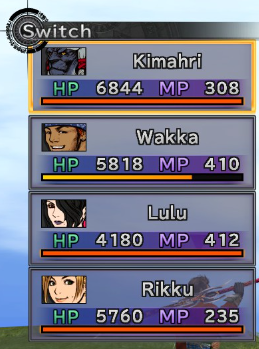
At this point, something else ought to be mentioned: Switching characters in is free and the character gets to act immediately. Rather than thinking of our sequence as 3 fixed characters, it is 3 temporary placeholders with 4 other characters that can be switched in at a moment’s notice. This means our sequences don’t need to be super strict character wise, and as such our counter-response character doesn’t need to worry about using actions that place him in the correct slot/placement in the turn order.
In general, knowing how a boss functions gives rise to the idea of wanting to respond to it, and responding to it more immediately, i.e. with a character immediately following it, makes sense too and is another example of attempting to use sequence to our benefit.
Interpretation
There isn’t much explicit use of sequence like with Copycat or deliberate combo strings, but there are some use cases for sequence that genuinely make a difference, such as during counterattacks or more generally, in response to an enemy’s move. In my opinion, part of the reason why having to think in sequences of characters isn’t more pronounced is due to the limited offerings of abilities in a strict turn-based system. Speed ranks on moves only go so far, and trying to figure out how much faster a regular attack is on Rikku vs. Auron so you can set up their sequence more deliberately is not easy with what information the game is offering - in what way does Agility affect it, exactly? Most moves in the game also hover around roughly the same speed rank. Creating more moves specifically so we could attach more granular ranks to them would require a much more thought out combo or sequence system to make use of it.